All About That Bass

bass its a bass

One band that I was in played at a party once. The host was mixing our soundcheck and the guitarist complained about the bass being loud. We were at the same volume. “Feel the bass! Feel the bass! God of thunder-r-r!” I said in my best Gene Simmons impression. Lower frequencies only “sound” louder, because of the increased air pressure. Know your physics.

My first bass (in the late 1980’s) was a 1970’s Gibson Ripper. The kind that Gene Simmons played on “KISS Alive!” Someone had modified it, adding a precision bass pickup in the middle. It had a solid set-neck maple body and sounded really good. It was only $100 dollars. They currently sell for thousands of dollars (no thanks to Nirvana and Green Day!). I had been playing guitar for a few years. But, I equally wanted to play both. Lacking much money, I tried to maximize the interchangeability between them. I purchased a 1960’s Guild Thunderbass amplifier head on a brand new crate 4×12, useful for both basses and guitars. I later also bought a 1970’s Rickenbacker 4001 bass. I got a good deal on it, just a few hundred dollars. I had to liquidate most of my possessions a couple of years ago, to avoid homelessness, and they were sadly sacrificed with some other gear that I miss.

Ripper & Rickenbacker Basses

I began playing bass around the time that the funk metal craze happened (Red Hot Chili Peppers, Faith No More, Primus). I liked those bands. But, I can’t really say that I tried to emulate them. I wanted to find my own voice, instead. My playing style got compared to Les Claypool a lot, even though I never slapped as well or as often as him. Maybe it was just because I played a lot of notes or something, instead of just playing the root note of the rhythm guitar. Maybe it was the only popular frame of reference people had. Anyway, I always looked to other players for little tricks or techniques. Most players use just their middle and index fingers. What I picked-up from Claypool was using ring-middle-index instead, making triplets and odd-meter rhythms easier to play.

I later discovered country guitarist Danny Gatton’s fingerpicking style, including the thumb like a banjo player. I am still working on that.

But, I usually reserve fingerpicking for when I am playing with a dry signal, no distortion or effects.

I prefer using a pick, recycled copper-nylon 1mm, to get more attack and articulation.

I prefer ground wound strings (GHS Brite Flats are the most readily available), brighter than flatwounds, but smoother than roundwounds.

I also looked for ideas to set my rig up with, borrowing and improving upon the peculiarities of some favorite bands and musicians. I was trying to fuse my guitar and bass set-ups together. Partially, this was because I was too poor to dedicate equipment money to both individual instruments. But, also, because I was trying to be more independent, relying less on another guitarist or another bassist. This, of course changed my playing style a little, as they were both sounding more alike. I never liked playing big chords on guitar a whole lot, except as a punctuation or color. But, I also didn’t like playing too many single notes on the bass, adding more chords to it.

Funk and jazz players usually got a good groove going. Admittedly, so did some disco and new wave players. Punk and metal players had the energy and heaviness. Progressive rock players had sophisticated compositions which were challenging. Blues, folk, and country players had soul. I try my best to integrate everything together.

I like to build-up a foundational base on something, a skeletal framework (like the rhythm section), and decorate it like a Christmas tree.

I am not a very good improviser, I admit.

If I have to come up with something on-the-fly I am more comfortable just playing a simple rhythm (or random noises) with a good drummer. Jam sessions aren’t always productive with me. But, I always try remembering to record everything when practicing. I can take that material back later, cut-and-pasting what we have got into a song. I call this “making Jam-Paste.” It is a slow-w-w-w-ass process though.

I work better alone. But, paradoxically, I often need someone around for motivation or I get depressed and nothing happens. I am trying to write more independently. But, it is taking me a long time to get used to it.


The End of Music

glitch_db41290f57_o

Noise is what punk rock wishes that it could be, but never will.

I believe that the use of noise to make music will continue and increase until we reach a music produced through the aid of electrical instruments which will make available for musical purposes any and all sounds that can be heard.

— John Cage The Future of Music: Credo (1937)
Noise music
From Wikipedia, the free encyclopedia:
Noise music is a category of music that is characterized by the expressive use of noise within a musical context. This type of music tends to challenge the distinction that is made in conventional musical practices between musical and non-musical sound. Noise music includes a wide range of musical styles and sound-based creative practices that feature noise as a primary aspect. It can feature acoustically or electronically generated noise, and both traditional and unconventional musical instruments. It may incorporate live machine sounds, non-musical vocal techniques, physically manipulated audio media, processed sound recordings, field recording, computer-generated noise, stochastic process, and other randomly produced electronic signals such as distortion, feedback, static, hiss and hum. There may also be emphasis on high volume levels and lengthy, continuous pieces. More generally noise music may contain aspects such as improvisation, extended technique, cacophony and indeterminacy, and in many instances conventional use of melody, harmony, rhythm and pulse is dispensed with.
The Futurist art movement was important for the development of the noise aesthetic, as was the Dada art movement (a prime example being the Antisymphony concert performed on April 30, 1919 in Berlin), and later the Surrealist and Fluxus art movements, specifically the Fluxus artists Joe Jones, Yasunao Tone, George Brecht, Robert Watts, Wolf Vostell, Dieter Roth, Yoko Ono, Nam June Paik, Walter De Maria’s Ocean Music, Milan Knížák’s Broken Music Composition, early LaMonte Young and Takehisa Kosugi.
Contemporary noise music is often associated with extreme volume and distortion. In the avant rock domain examples include Jimi Hendrix’s use of feedback,Lou Reed’s Metal Machine Music, and Sonic Youth. Other examples of music that contain noise-based features include works by Iannis Xenakis, Karlheinz Stockhausen, Helmut Lachenmann, Cornelius Cardew, Theatre of Eternal Music, Glenn Branca, Rhys Chatham, Ryoji Ikeda, Survival Research Laboratories, Whitehouse, Brighter Death Now, Merzbow, Cabaret Voltaire, Psychic TV, Blackhouse, Jean Tinguely’s recordings of his sound sculpture (specifically Bascule VII), the music of Hermann Nitsch’s Orgien Mysterien Theater, and La Monte Young’s bowed gong works from the late 1960s. Genres such as industrial, industrial techno, lo-fi music, black metal, sludge metal, and glitch music employ noise-based materials.

https://youtu.be/dYtzNl48F60

Plastic Man


Occasionally, I hit upon an idea for a movie or a book that I would like to do. Usually, nothing comes of it because I lack the resources to do anything about it.

Well, lately I was thinking about how Marvel comics movies are usually better than DC’s… at least in the last two decades.

I think DC should push for a Plastic Man movie.
Why Plastic ManWell, he was so different from any other character in their roster. DC Comics acquired many of the characters from Quality Comics when it was shut down in 1956, integrating Plastic Man into the mainstream DC Universe. The Plastic Man comics were more surreal and funnier than most other superheroes. I remember him from Saturday Morning cartoons when I was a kid. But, he was always a “D-list” character compared to big names like Superman, Batman, or Wonder Woman.

He is a total wise-ass kind of character. He uses his powers for totally mundane things, like getting a beer from the fridge without leaving his chair. His backstory is kind of like The Joker’s. He was formerly a criminal, who was shot and then doused with a mysterious chemical which transformed him. Instead of becoming a super-criminal, though, he acquires powers kind of like Reed Richards / Mister Fantastic from the Fantastic Four. His morals aren’t always perfect. He is just like a regular dude who wants make an easy buck. He, in fact, once flipped a coin to decide whether to use his powers for criminal purposes or not. He decides to become a private investigator, and later an FBI agent, using his experience in the criminal underworld to fight crime. In some ways he is like The Green Hornet, using his old identity and connections to get what he needs to do so.

Guardians of the Galaxy‘s success as a movie last year proved that you could take a relatively unknown comic book property and make it into a big hit. It made Chris Pratt a movie star overnight.

The Wachowski siblings, who made The Matrix trilogy wrote a script for a Plastic Man movie twenty years ago. It almost got made in 2009 and would have starred Keanu Reeves. But, then it got shelved again.

Personally, I would like to see either Jim Carrey or Bruce Campbell play the role. Both of them share that style of physical humor. I would like it very much if the setting of such a film be created sort of like the 1990 film version of Dick Tracy. It just feels so appropriate for this kind of story.

Could I make this movie? Unlikely. I don’t have the kind of budget or connections that would be required to do it any justice. If Warner Brothers or some big studio wanted to throw a pile of money at me to make it I could try. But, I feel more comfortable as a writer than as a director. That is why I haven’t made The Island of Misfit Noise movie by myself already. I know that there are other people who could put the ideas onto the screen better than I could. I kind of feel like I could be a writer-producer in the way that Gene Roddenberry was for Star Trek. He knew where to find the people that were more talented than him and handed his ideas off to them and let them take it from there.


Powers and abilities

Malleable Physiology: Plastic Man’s powers are derived from an accident in which his body was bathed in an unknown industrial chemical mixture that also entered into his bloodstream through a gunshot wound. This caused a body-wide mutagenic process that transformed his physiology. Eel exists in a fluid state, neither entirely liquid nor solid. Plastic Man has complete control over his structure.
Density Control: Plastic Man can change his density at will; becoming as dense as a rock or as flexible as a rubber band.
Malleability (Elasticity/Plasticity): He can stretch his limbs and body to superhuman lengths and sizes. There is no known limit to how far he can stretch his body.
Size Alteration: He can shrink himself down to a few inches tall (posed as one of Batman’s utility belt pockets) or become a titan (the size of skyscrapers).
Shape-Shifting: He can contort his body into various positions and sizes impossible for ordinary humans, such as being entirely flat so that he can slip under a door or using his fingers to pick conventional locks. He can also use it for disguise by changing the shape of his face and body. Thanks to his fluid state, Plastic Man can open holes in his body and turn himself into objects with mobile parts. In addition, he can alter his bodily mass and physical constitution at will; there is virtually no limit to the sizes and shapes he can contort himself into.
Superhuman Agility: These stretching powers grant Plastic Man heightened agility enabling him flexibility and coordination that is extraordinarily beyond the natural limits of the human body.
Superhuman strength: He can alter his strength by growing or adding more muscle.
Color Change: The only limitation he has relates to color, which he cannot change without intense concentration. He generally does not use this ability and sticks to his red and yellow colored uniform.
Invulnerability: Plastic Man’s powers extraordinarily augment his durability. Some stories, perhaps of anecdotal quality, have showed him susceptible to surprise attack by bullets, in one case oozing a substance similar to liquid plastic. In most stories, though, he is able to withstand corrosives, punctures and concussions without sustaining any injury (although he can be momentarily stunned). He is resistant to high velocity impacts that would kill an ordinary person, resistant to blasts from energy weapons (Batman once mentioned that he could presumably even withstand a nuclear detonation), and is bulletproof. His bodily mass can be dispersed, but for all intents and purposes it is invulnerable.
Regeneration: He is able to regenerate and/or assimilate lost or damaged tissue, although he needs to be reasonably intact for this process to begin; he was reduced to separate molecules and scattered across the ocean for centuries, only returning to his usual form after the rest of the League were able to gather enough of his molecules and restore approximately 80% of his body mass, after which he began to regenerate what they hadn’t salvaged.
Telepathic Immunity: As stated by Batman (in JLA #88, Dec. 2003), “Plastic Man’s mind is no longer organic. It’s untouchable by telepathy.”
Immortality: Plastic Man does not appear to age; if he does, it is at a rate far slower than that of normal human beings. In the aftermath of the Justice League story Arc “Obsidian Age”, Plastic Man was discovered to have survived for 3000 years scattered into separate molecules on the bottom of the Atlantic Ocean. He is now over 3000 years old and is still active as a superhero.
Ultrasonic Detection: His body will start to “ripple” when an ultrasonic frequency is triggered.
Rubber-Organs: As stated by Black Lantern Vibe, Plastic Man’s internal organs such as his heart when Black Lantern Vibe try to rip it out couldn’t be killed unlike many of the Black Lanterns’ victims, this makes him immune to such attacks.
Skilled thief: Plastic Man was once a very talented professional thief.
Master Detective: Although no longer a criminal, he has insight into their mindset, enabling him to be an effective sleuth. He is also considered to be a lateral thinker and much smarter than he lets on.

Hello!

“All the various styles are organically connected to one another. I’m an additive person—the entire storehouse of my knowledge informs everything I do. People are so obsessed with the surface that they can’t see the connections, but they are there.” ~ John Zorn

“Cute, cool, and creepy”, is how I have been described by some folks.

Usually, I am classified by my contemporaries as an outsider artist-musician.

Davin Brainard (time Stereo) and Warren DeFever (His Name Is Alive) shared their observation about me that I don’t intentionally TRY to be perceived as weird, I just naturally AM, making comparisons to Wesley Willis and Daniel Johnston. I guess that I will just go along with those descriptions.

Outsider Artist / Musician;

  • Music, Art, and Zines
  • Videos, Movies, and Multi-Media
  • Voice, Tapes, and Noise
  • Bass, Baritone, and other Guitars
  • Keyboards, Computers, and Custom Instruments
  • Plunderphonics, Electronics and Junk Percussion

I enjoy creating what I usually refer to as “Prog-Punk Noise-Rock”, kind of a strange postmodern pastiche of styles mixed together. I have collaborated with plenty of other artists over the years with wide degrees of proficiency in many genres.

I have been obsessively into art and music my whole life; drawing, painting, playing with tape recorders and making noise. I built my first guitar from a badly beaten-up body & neck that I found in someone’s trash. A friend’s dad gave me the electrical guts from an unknown 1950’s guitar. Additional parts were improvised from pieces of found junk and purchased from a music store.

When I was a twelve year old kid, back in the 1980’s, I was just a runt of the Detroit hardcore punk / heavy metal scene . Lacking enough money to buy any good equipment, I purchased a cheap microphone at a pawn shop, built a homemade mic stand, and passed myself off as a vocalist. I sang in whatever groups that I could find, gaining experience and learning whatever that I could. Mostly, it was shitty cover bands, playing in basements, getting yelled at by uninvited drunks that we suck. Eventually, I improved my bass & guitar skills, playing in many short-lived groups that went nowhere.

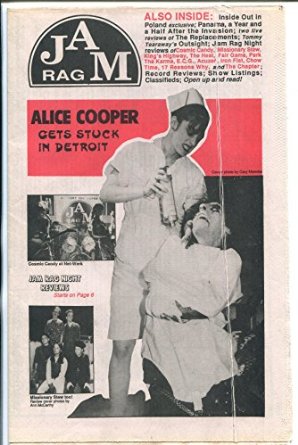
I was a writer / photographer for The Jam Rag, a widely-read local music paper, while still a teenager and made friends with other artists along the way. During the 1990’s I was a cameraman, roadie, and occasional collaborator with Princess Dragon-Mom, Mog Stunt Team, His Name Is Alive, etc.. I also performed in a few experimental noise groups; Edible Audio (with drummer Mick Stone of 500 ft of Pipe) and Bionics (with John Nevermind of Fresh Farm Raised Catfish), etc.

The Island of Misfit Noise began in the summer of 1998 with only Mystic MarshaKat and myself. She played keyboards & guitar. I played bass & guitar. Both of us were former members of N2-Submission, backing band for The Impaler “Detroit’s Vampire Poet.” Our duo’s name changed a couple of times, before settling on the IOMN.  Other musicians came and went during a period of 15 years, with she & I being the only constant members of the group. She also left in early 2013. MarshaKat and I remain friends. She may continue to assist in some capacity, just not as a full-time band member.

I resurrected the IOMN as a recording project in late 2014, with collaborators from Michigan to Australia. We exchanged material back-and-forth until some music was completed. The style that we made is very freeform. A few collaborators from the IOMN have joined me in other projects.

MickeyBugsBand_1

♛ ★ ★ ★ ★ ★ ★ ☆ Prog ☆ Punk 🐱 Noise ☆ Rock ☆ ★ ★ ★ ★ ★ ★ ♛

Some of my current projects;

  • Island of Misfit Noise began in 1998 as a musical group, with a constantly rotating membership. It has since evolved into, generally, a “Mike Nobody Collaboration Project”, expanding into; music videos, film-making, performance art, and comic books. I will continue to add material to this as I go along, with additional contributors.
  • Theee Urban SpaceCat (Cassette-Zine) is a publication of my artwork, ramblings, stories, correspondences, miscellaneous found objects, music, commentary, and anything else packaged with a cassette tape of my recordings (compact disc optional)… whatever they may be. It is an outlet for all of my artistic endeavors, combined into one package, modeled after decades of correspondence with my friends.
  • Mike Damn Nobody is my experimental noise project; incorporating tape loops, circuit-bending, custom instruments, and anything else available. Recordings are available on RecycleTapes (cassettes that are handmade from repurposed materials) and digital download formats.
  • MykNobody is a handle sometimes used when I am Painting, Drawing, creating Visual Art, etc.

This post was a little long, containing influences, gear, personal info, etc.. It has been relocated to About / FAQ / Press – Details.

Subscribe to this blog and I will show & tell you more about the past, present, and future. If you want to check out upcoming events or new stuff available, and get some freebies, add yourself onto the mailing list in the sidebar. There is also a Ko-Fi fundraising link there for anybody who wants to support my creative efforts.

Thanks!

Mike Nobody =^.^=

We Make Zines (Relocated Site)

We Make Zines

I forgot to update everybody on this. A few months ago, the website for We Make Zines had to relocate when they lost their web hosting provider. I had been a member since 2014. So, I reopened an account at the new site. All of my previous postings have been lost. So, aside from my profile, there isn’t much of mine to look at yet. Zinesters and enthusiasts can find plenty of other information there, though. The link is above.

NegativeM+ Complete!

Hi all,

Been busy! Busy, busy, busy. We seemed to have secured a stable practice space and completed our lineup, practically no thanks to Bandmix! Craigslist gets most of the credit.

Both drummers are in the auto parts / repair industries, which should come in handy. Our newest guy is quite proficient with home studio gear. He’s supposed to be helping us figure out our MIDI stuff in the next week. So, that’s cool. His other band seems to have the habit of falling ass-backwards into paying gigs without trying. Hopefully, that will come in use for us too.

So, besides my girlfriend and I, we’ve got a Deadhead, a metalhead, and a noisehead. Basically, everyone we got is tired of the music they hear on the radio and tired of the usual bands they’ve played in. So, our experimental nature is a good fit for them.

Considering the good response we got from our ads and the number of people we never even got to meet up with, we’ll keep the door open if anyone doesn’t mind being a “temp” or “Fake Shemp” for the band. Basically, they’ll help out with transporting equipment, selling merch, covering the door, et cetera. They can jam onstage with us for a couple songs and fill-in for members who become incapacitated due to illness, injury, or whatever.

Photobucket

Hopefully, the newest guy will get settled in his new place he moved to and we’ll get busy on demo’ing some new stuff. The other drummer is fixing up an old Volvo wagon to transport stuff in. So, we should be in business by this summer.

New Channel at LiveVideo!


Well, I got tired of YouTube (deleting my account, four attempts at a director’s account, crummy site hardly ever works, etc.). So, I’m moving. I’ll keep my YouTube account open and check out anything new there. But, I’m focusing my energies where they’ll get better results (got a director’s account first day and doubled the file size I can upload, the software seems to work better, the community is already gelling really well. It looks good)