Ultra Bidé

Ultra Bide Hide Fujiwara

Here is another group that I like very much. I have been listening to these guys for years and years. Touring with them would be pretty awesome if the opportunity ever came up.

Japanese experimental punk trio Ultra Bidé was formed in 1978 by Hide Fujiwara (bass / guitar / vocals) and released their first song in 1980 on the five-band compilation Dokkiri Record. It’s sort of the No New York of Japan’s south-central Kansai region (which contains Osaka and Kyoto), and Ultra Bide’s contribution, the dissonant “1979!,” bolsters its babbling vocals and thwacking bass with thunderclaps of guitar. After the band’s debut full-length, 1984’s The Original Ultra Bide, it took them 11 years to put out another, at which point they dropped three between 1995 and 2003—and 2013’s DNA vs. DNA-c (Alternative Tentacles) is their first since then. These guys can still make a whole lot of noise (“Phase Is Massive Power Attack Weapon” consists mostly of reverberating guitar feedback), but they’re also great at cleaner, more melodic tunes built from blunt guitar jabs and driving, nimble bass lines.

For many years, they were a standard power trio of guitar, drums, and bass. But, in recent years, they have eschewed the guitar for a two-bassist lineup. It is a really bad-ass sound. Their last album was recorded entirely at home, then mixed & mastered in professional studios. Definitely my way of doing things!

Ultra Bide - 1

Stripping It Down

"Our life is frittered away by detail... simplify, simplify." - Henry David Thoreau
“Our life is frittered away by detail… simplify, simplify.” – Henry David Thoreau

I am stripping my rig down a bit.

Still a work in progress.

I am trying to fit everything onto the pedalboard.

There may still be a few things sticking out.

Ideally, I should be able to set up my gear in about ten minutes, give or take a few.

Fewer parts, fewer complications.

Gotta think like a NASCAR pit mechanic, in & out.

“The more they overthink the plumbing, the easier it is to stop up the drain.”

– Scotty (Star Trek III: The Search For Spock)

My equipment has evolved a lot over time.

At one point, I had a built-up a huge Frankenrig from two old PAs, some preamps, and pieces of my current Mini-rig.

I got inspiration for my setup from a bunch of different bass & guitar players; Bootsy Collins, Chris Squire, Cliff Burton, Greg Ginn.

Some players have elaborate switching systems, with tons of pedals and rackmount effects.

Some players have truckloads of gear, insane shit.

Sonic Youth had a different guitar for EACH SONG.

I am trying to pare it down to whatever my live sound will be.

What do I REALLY need?

Other effects and sounds that I use I will probably just record samples of.

This changes the dynamics of composing quite a lot.

It is gonna sound way different than if I had everything plugged into the bass.

You can sort of hear how this is shaping my sound, so far.

But, this is for demonstration purposes ONLY (sorry that I got fat):

This is an unfinished song that The Riverviews were working on a couple of months ago.

I might re-purpose it into an Island of Misfit Noise song, if Mike Hayes doesn’t mind.

Stripping down the mini-rig.
Trying to find a compromise between my “live sound” and “studio sound”.
The strings are long overdue to be changed.
But, I haven’t got enough money for replacements.

I’m A Loser, Baby (So, Why Donch’ya Kill Me?)

My Name

Besides artists from the outsider music genre (Wesley Willis, Daniel Johnston), I have also been compared to a few other people. It didn’t always annoy me. Some comparisons were flattering, I thought. But, this is kind of how I came to be known as Mike Nobody.

Corey Feldman:

Frog brother truth justice american way

Honestly, I do not know where anyone got this from. Is there a physical resemblance? I dunno. Maybe a little. I guess there are worse things than being a Goonie, a Teenage Mutant Ninja Turtle, or one of the Frog brothers from “Lost Boys.”

Thurston Moore:

Sonic Youth - Thurston

I didn’t mind this one very much. Kenny Mugwump ( bassist / vocalist for groups like Princess Dragon-Mom, Mog Stunt Team, Loudhouse) made this observation a few times. I don’t know why. Maybe, like Thurston Moore, I know a lot about music history and collect a lot of it.

Beck Hansen:

A few pen-pals made a comparison between me and Beck, a couple of times. This is quite funny to me. I began using Mike Nobody as an ironic commentary on the whole Grunge / Loser thing. When asked what my musical style is, I used to jokingly tell people that it was just “Beck, with a bass.”

Kurdt Kobain:

At the peak of Nirvanamania, I do not think hardly a day went by when someone didn’t tell me, “Oh, my GAWD, you are just like Kurt Cobain!” AAAAAAAAAAAAAUUUUUUUUUUGGGGGGGGHHHHH! This annoyed me to no fucking end! I was followed and constantly harassed by a Cobain-obsessed stalker for months and months. I ended up fucking her, just to make her go away! I eventually had to move TWICE to lose her. I know that I should feel bad for saying this. But, it was kind of a relief when he died. That is about when those comparisons stopped happening.

On the upside of this, it landed me a role in a biopic about him, a few years after his death. The movie began as an independent film, then got bought by HBO (who increased our budget by a LOT). But, it seemed like the script was being rewritten every week. The story that they were going with became more fictionalized and ridiculous each time (Kurt Cobain becomes a zombie?).  I got fed up with it and quit. Production fell apart shortly thereafter. However, the project started up again when they brought in Gus Van Sant to direct. The finished movie became “Last Days”. It stunk. My only regret is that, if I had stayed in the movie, I could have met Kim Gordon (bassist / vocalist from Sonic Youth). She had a role in it too.

No one ever called me by my given name, not even as a child. I later discovered that my surname is a lie (I never liked it anyway). So, I only felt like my middle name, Michael, was my real name. What eventually made me settle on using the pseudonym Mike Nobody was the recommendation from Rob Wright (bassist / vocalist from NoMeansNo) to keep it, after I sent him a letter with that as my name. Hey, it was good advice. So, it has been my pen & stage name ever since.

Just because I dig your music, doesn’t mean I have to like your dumb ass!

ASSHOLES Pink Flamingos

Separating an artist from their work can sometimes be difficult. It stirs mixed emotions and makes us question ourselves. It makes us see our heroes as the flawed human beings that they really are.

In 2015, Bill Cosby has been revealed (by his own words, under oath) to be a serial rapist. Does that mean I can’t enjoy his work anymore?

No.

The comedy albums that he recorded, that I grew up with, are still classic. I still love them. I still like Fat Albert, The Cosby Show, and some other work that he did in film and television. But, I won’t be giving him any of my money anymore.

The Bad Brains are one of the greatest hardcore punk bands of all time. Being one of the few all-black groups in that scene certainly made them trailblazers as well. But, they are (at least they were, back in the 1980’s) extremely homophobic.

During the summer of 1982 they became involved in the Rock Against Reagan Tour, during which time they fell out with the band MDC when Rastafarian singer H.R. learned that Big Boys‘ singer, Randy Turner, was gay. H.R. and MDC‘s Dave Dictor had an intense confrontation. Upon Bad Brains‘ departure from the bill, they refused to return a loan owed to Big Boys and instead left a note that reportedly read, “burn in hell bloodclot faggot.” The incident resulted in the MDC song “Pay to Come Along.”

“First let me say I hated that whole incident. MDC adored the Bad Brains 1980-1982. After a gig where we really hit it off together in Oakland, we dropped everything in our lives to go across country on a mini tour with them on 2 days notice. Ended up playing 2 shows with them. One in Houston and the infamous one in Austin where we dropped off the tour. There in Austin they freaked out in the middle of the show about Gary Floyd’s and Randy Biscuit’s out gayness and refused to sing using the same microphone as them. The Bad Brains seemed to always have these much younger people in the scene around them. And it seemed no would call them on their bullshit. We were about the same age as them and a bit more politically sophisticated then the typical people in the DC and NY scene.

I only felt mistreated in that they came into a show that MDC and others had set up and hurled a lot of insults and anger towards our friends. Insults like “All gay people are blood clot faggots and they should be put to death.” It wasn’t like they expressed that they didn’t like gay people and disapprove of their lifestyle. It was wishing death for the singers of two of our favorite bands in our original punk rock home town. It was sad to see it all go down and didn’t feel good at all. It was confusing that we could adore and agree with people about many political topics including human rights, yet disagree about homosexuality. With HR-Joseph we have never resolved anything, but with Darryl and Dr Know (the bassist and guitarist), we all expressed regrets on the topic years later.”

P.M.A. (Positive Mental Attitude) my ass!

Politically conservative rock & roll musicians are an oddity. Rock & roll, by definition, is anti-authoritarian and anti-conservative. Ted Nugent, Lee Ving, and Johnny Ramone never seemed to understand that.

I don’t understand how Alice Cooper, Dave Mustaine, or Ozzy Osbourne can go on about Christianity and keep a straight face.

Some artist’s work can also be questionable (or just plain vile). But, I may appreciate certain aspects of it, regardless.

Lemmy Kilmister of Motorhead has long been criticized for his collection of Nazi paraphernalia. But, no serious person believes that he holds any sympathies for them or their ideology.

Lemmy
From Wikipedia, the free encyclopedia:

Lemmy collects German military regalia, and has an Iron Cross encrusted on his bass, which has led to accusations of Nazi sympathies. He has stated that he collects this memorabilia for aesthetic values only, and considers himself an anarchist or libertarian, and that he is “anti-communism, fascism, any extreme,” saying that “government causes more problems than it solves”.

Jeff Hanneman, the late founder of the thrash metal band Slayer, befriended Lemmy due to their shared fondness for collecting Nazi memorabilia. According to Keith Emerson’s autobiography, two of Lemmy’s Hitlerjugend knives were given to Emerson by Lemmy during his time as a roadie for The Nice. Emerson used these knives many times as keyholders when playing the Hammond organ during concerts with The Nice and Emerson, Lake & Palmer, often before destroying them.

Some stuff that I like, I know is just totally horrible and in bad taste. It doesn’t make me a bad person, though.

Overall, if you don’t want to support someone because they offend you, then don’t. Save your money. Give it to someone more worthy. Meanwhile, enjoy whatever art & music that you enjoy. If other people don’t like that, fuck ’em.

The End of Music

glitch_db41290f57_o

Noise is what punk rock wishes that it could be, but never will.

I believe that the use of noise to make music will continue and increase until we reach a music produced through the aid of electrical instruments which will make available for musical purposes any and all sounds that can be heard.

— John Cage The Future of Music: Credo (1937)
Noise music
From Wikipedia, the free encyclopedia:
Noise music is a category of music that is characterized by the expressive use of noise within a musical context. This type of music tends to challenge the distinction that is made in conventional musical practices between musical and non-musical sound. Noise music includes a wide range of musical styles and sound-based creative practices that feature noise as a primary aspect. It can feature acoustically or electronically generated noise, and both traditional and unconventional musical instruments. It may incorporate live machine sounds, non-musical vocal techniques, physically manipulated audio media, processed sound recordings, field recording, computer-generated noise, stochastic process, and other randomly produced electronic signals such as distortion, feedback, static, hiss and hum. There may also be emphasis on high volume levels and lengthy, continuous pieces. More generally noise music may contain aspects such as improvisation, extended technique, cacophony and indeterminacy, and in many instances conventional use of melody, harmony, rhythm and pulse is dispensed with.
The Futurist art movement was important for the development of the noise aesthetic, as was the Dada art movement (a prime example being the Antisymphony concert performed on April 30, 1919 in Berlin), and later the Surrealist and Fluxus art movements, specifically the Fluxus artists Joe Jones, Yasunao Tone, George Brecht, Robert Watts, Wolf Vostell, Dieter Roth, Yoko Ono, Nam June Paik, Walter De Maria’s Ocean Music, Milan Knížák’s Broken Music Composition, early LaMonte Young and Takehisa Kosugi.
Contemporary noise music is often associated with extreme volume and distortion. In the avant rock domain examples include Jimi Hendrix’s use of feedback,Lou Reed’s Metal Machine Music, and Sonic Youth. Other examples of music that contain noise-based features include works by Iannis Xenakis, Karlheinz Stockhausen, Helmut Lachenmann, Cornelius Cardew, Theatre of Eternal Music, Glenn Branca, Rhys Chatham, Ryoji Ikeda, Survival Research Laboratories, Whitehouse, Brighter Death Now, Merzbow, Cabaret Voltaire, Psychic TV, Blackhouse, Jean Tinguely’s recordings of his sound sculpture (specifically Bascule VII), the music of Hermann Nitsch’s Orgien Mysterien Theater, and La Monte Young’s bowed gong works from the late 1960s. Genres such as industrial, industrial techno, lo-fi music, black metal, sludge metal, and glitch music employ noise-based materials.

Hello!

“All the various styles are organically connected to one another. I’m an additive person—the entire storehouse of my knowledge informs everything I do. People are so obsessed with the surface that they can’t see the connections, but they are there.” ~ John Zorn

“Cute, cool, and creepy”, is how I have been described by some folks.

Usually, I am classified by my contemporaries as an outsider artist-musician.

Davin Brainard (time Stereo) and Warren DeFever (His Name Is Alive) shared their observation about me that I don’t intentionally TRY to be perceived as weird, I just naturally AM, making comparisons to Wesley Willis and Daniel Johnston. I guess that I will just go along with those descriptions.

Outsider Artist / Musician;

  • Music, Art, and Zines
  • Videos, Movies, and Multi-Media
  • Voice, Tapes, and Noise
  • Bass, Baritone, and other Guitars
  • Keyboards, Computers, and Custom Instruments
  • Plunderphonics, Electronics and Junk Percussion

I enjoy creating what I usually refer to as “Prog-Punk Noise-Rock”, kind of a strange postmodern pastiche of styles mixed together. I have collaborated with plenty of other artists over the years with wide degrees of proficiency in many genres.

I have been obsessively into art and music my whole life; drawing, painting, playing with tape recorders and making noise. I built my first guitar from a badly beaten-up body & neck that I found in someone’s trash. A friend’s dad gave me the electrical guts from an unknown 1950’s guitar. Additional parts were improvised from pieces of found junk and purchased from a music store.

When I was a twelve year old kid, back in the 1980’s, I was just a runt of the Detroit hardcore punk / heavy metal scene . Lacking enough money to buy any good equipment, I purchased a cheap microphone at a pawn shop, built a homemade mic stand, and passed myself off as a vocalist. I sang in whatever groups that I could find, gaining experience and learning whatever that I could. Mostly, it was shitty cover bands, playing in basements, getting yelled at by uninvited drunks that we suck. Eventually, I improved my bass & guitar skills, playing in many short-lived groups that went nowhere.

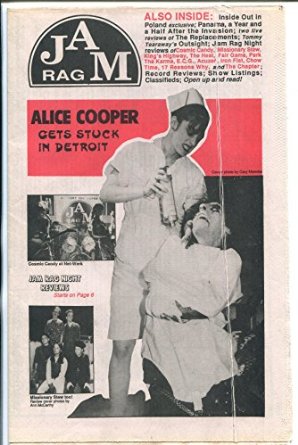
I was a writer / photographer for The Jam Rag, a widely-read local music paper, while still a teenager and made friends with other artists along the way. During the 1990’s I was a cameraman, roadie, and occasional collaborator with Princess Dragon-Mom, Mog Stunt Team, His Name Is Alive, etc.. I also performed in a few experimental noise groups; Edible Audio (with drummer Mick Stone of 500 ft of Pipe) and Bionics (with John Nevermind of Fresh Farm Raised Catfish), etc.

The Island of Misfit Noise began in the summer of 1998 with only Mystic MarshaKat and myself. She played keyboards & guitar. I played bass & guitar. Both of us were former members of N2-Submission, backing band for The Impaler “Detroit’s Vampire Poet.” Our duo’s name changed a couple of times, before settling on the IOMN.  Other musicians came and went during a period of 15 years, with she & I being the only constant members of the group. She also left in early 2013. MarshaKat and I remain friends. She may continue to assist in some capacity, just not as a full-time band member.

I resurrected the IOMN as a recording project in late 2014, with collaborators from Michigan to Australia. We exchanged material back-and-forth until some music was completed. The style that we made is very freeform. A few collaborators from the IOMN have joined me in other projects.

MickeyBugsBand_1

♛ ★ ★ ★ ★ ★ ★ ☆ Prog ☆ Punk 🐱 Noise ☆ Rock ☆ ★ ★ ★ ★ ★ ★ ♛

Some of my current projects;

  • Island of Misfit Noise began in 1998 as a musical group, with a constantly rotating membership. It has since evolved into, generally, a “Mike Nobody Collaboration Project”, expanding into; music videos, film-making, performance art, and comic books. I will continue to add material to this as I go along, with additional contributors.
  • Theee Urban SpaceCat (Cassette-Zine) is a publication of my artwork, ramblings, stories, correspondences, miscellaneous found objects, music, commentary, and anything else packaged with a cassette tape of my recordings (compact disc optional)… whatever they may be. It is an outlet for all of my artistic endeavors, combined into one package, modeled after decades of correspondence with my friends.
  • Mike Damn Nobody is my experimental noise project; incorporating tape loops, circuit-bending, custom instruments, and anything else available. Recordings are available on RecycleTapes (cassettes that are handmade from repurposed materials) and digital download formats.
  • MykNobody is a handle sometimes used when I am Painting, Drawing, creating Visual Art, etc.

This post was a little long, containing influences, gear, personal info, etc.. It has been relocated to About / FAQ / Press – Details.

Subscribe to this blog and I will show & tell you more about the past, present, and future. If you want to check out upcoming events or new stuff available, and get some freebies, add yourself onto the mailing list in the sidebar. There is also a Ko-Fi fundraising link there for anybody who wants to support my creative efforts.

Thanks!

Mike Nobody =^.^=

NegativeM+ Complete!

Hi all,

Been busy! Busy, busy, busy. We seemed to have secured a stable practice space and completed our lineup, practically no thanks to Bandmix! Craigslist gets most of the credit.

Both drummers are in the auto parts / repair industries, which should come in handy. Our newest guy is quite proficient with home studio gear. He’s supposed to be helping us figure out our MIDI stuff in the next week. So, that’s cool. His other band seems to have the habit of falling ass-backwards into paying gigs without trying. Hopefully, that will come in use for us too.

So, besides my girlfriend and I, we’ve got a Deadhead, a metalhead, and a noisehead. Basically, everyone we got is tired of the music they hear on the radio and tired of the usual bands they’ve played in. So, our experimental nature is a good fit for them.

Considering the good response we got from our ads and the number of people we never even got to meet up with, we’ll keep the door open if anyone doesn’t mind being a “temp” or “Fake Shemp” for the band. Basically, they’ll help out with transporting equipment, selling merch, covering the door, et cetera. They can jam onstage with us for a couple songs and fill-in for members who become incapacitated due to illness, injury, or whatever.

Photobucket

Hopefully, the newest guy will get settled in his new place he moved to and we’ll get busy on demo’ing some new stuff. The other drummer is fixing up an old Volvo wagon to transport stuff in. So, we should be in business by this summer.

What Makes People Want to Play Rock Band and Guitar Hero?

What Makes People Want to Play Rock Band and Guitar Hero?
By Gary Marcus
Director of the NYU Infant Language Learning Center, and Professor of Psychology at NYU

In some ways, Guitar Hero and Rock Band seem like the stupidest games on earth. Colored discs scroll down a TV screen, and eager participants mash colored buttons in time with what they see. You press a red button when you see a red disc, a blue button when you see a blue disc, and hold your fire when you see nothing. Rinse, lather, and repeat; that’s about all there is to it. Since the sequence and timing are provided by the game software, you don’t really even need to know the songs. There’s no need to strategize ahead (as in chess); no need for big muscles (as in basketball), and no need to bluff past one’s opponent (as in poker). Few games demand less of the player; I suspect monkeys could be trained to play, and know for a fact that robots can cruise through Guitar Hero on Expert.

Yet the two games together have grossed over three billion dollars, and received extensive coverage in highbrow outlets like The New York Times and The Atlantic Monthly.

What is the appeal of a game that demands so little of the human mind? Part of it of course lies with the music; the latest Rock Band comes complete with Beatles music, and for people like me, who grew up listening to music, no body of music is more compelling. (For people with rather different tastes, there’s Guitar Hero: Metallica and Guitar Hero: Aerosmith, with Steely Dan allegedly on its way, although Jimmy Page swears there will never be a Guitar Hero: Led Zeppelin).

Still, at $60, the game costs as much as 4 or 5 albums, and the game takes more work to play. Why mash buttons on a video game controller, when you could put Sgt. Pepper on your CD player, or learn to play a real guitar? If an alien scientist came to observe humanity, they’d find a lot of things puzzling, but few would be as puzzling as Guitar Hero.

* * *
Some games, of course, could be seen as practice for the real world; Monopoly could be viewed as preparation for a career in real estate, chess for the art of war. Many evolutionary psychologists believe that play evolved as way to ease children into their ultimate adult responsibilities; chasing your friends in a game of tag prepares you for the bison hunt on which your life will later depend.

Whether you buy that theory or not, the plastic “guitars” in Guitar Hero have little to do with real guitars; there are no strings, and no frets, there’s no soundhole, and no jack to hook up to an amplifier, either; except for a bit of clattering, the plastic pseudo-instrument makes no sound at all. And there’s no room for genuine creativity, as there would be with a real instrument. A real apprentice guitarist must spend hours and hours practicing scales and chords, and learning about the relation between melody and harmony; an aficionado of Guitar Hero skips straight to the songs, and may well never learn the difference between a major scale and a minor.

Economists would be puzzled, too. It generally costs the same amount or even less (once you factor out the costs of the plastic guitars) to buy the songs on iTunes as to get them in a package for your Xbox, and if you buy them on iTunes, you can play them over and over, wherever you want, in the car, or in the gym, and not just when you stand in front of your television set. You also aren’t stuck suffering through the abominable mid-80’s Hair Metal, in order to “unlock” the next song that you actually like.

What gives? If it’s not practice for a career in music, and it’s not efficient or rational from an economist’s perspective, what is it that drives people to play these games?

* * *
It’s a lust for power.

Not, mind you, of the sort that allows one to rule the world, but the sort that allows one to control one’s own world.

Dozens of studies over the years have shown that human beings are happier when they believe themselves to be in control. In one famous set of studies, participants were asked to solve simple arithmetic problems while sitting in a room in which sudden blasts of noise occurred at random intervals. One group of subjects had no choice but to listen, the others had a panic button they would be allowed to press if the noise became too much. Though few participants actually pressed the button, the mere feeling of control made the entire experience considerably more bearable. In another famous study, dogs were put in an environment in which nothing that they did correlated with their situation; so-called “learned helplessness” — essentially a form of depression — was the result.

Alas, although humans are very fond of being in control, we aren’t always so good at telling whether we actually have it. As Harvard psychologist Dan Wegner has argued in The Illusion of Conscious Will, Oujia boards were designed to trick people into thinking they didn’t have control when they really did. Guitar Hero is designed to do the opposite.

Inferring control is really an exercise in inferring causality; we want to know whether A causes B, but sometimes all we know is that when A happens, B happens too. In technical jargon, we infer causality from temporal contingency.

Games like Guitar Hero set up one of the most potent illusions of temporal contingency I’ve ever seen: if the player presses the button at the right time, the computer plays back a recording of a particular note (or set of notes) played by a professional musician. The music itself is potent and rewarding — Keith Richards really knows how to bend a note — but the real secret to the game is what happens is that fact if you miss the button, you don’t hear the note.

The brain whirs away, and notices the contingency. When I push the button, I hear Keith Richards; when I fail to push the button (or press the wrong button, or press it late), I don’t hear Keith Richards. Therefore, I am Keith Richards!

* * *
It’s not simply that you hear the songs (which bring pleasure) but that the game skillfully induces the illusion that you yourself are generating the songs. You aren’t paying $60 to hear the songs; you’re paying $60 to trick your brain into thinking that you are making them. Your conscious mind may know better — and realize that it’s all just a ruse — but your unconscious mind is completely and happily fooled.

Is that worth $60? If you want to feel like Keith Richards, the answer is surely yes.


Digg!