
Watch more at http://www.theyoungturks.com

Introduction: Diversity Of Thinking – Richard Dawkins @ University Of Oklahoma March 2009: Response to OK Resolution (State Representative Todd Thomsen).
This is Richard Dawkins’ special introduction to his lecture at the University of Oklahoma on March 6th, 2009. See more about the events surrounding his visit here: http://richarddawkins.net/article,3641,Oklahoma-legislator-proposes-resolution-to-condemn-Richard-Dawkins,Todd-Thomsen
Richard Dawkins is the Charles Simonyi Professor of the Public Understanding of Science at Oxford University. He was voted Britain’s leading public intellectual by readers of Prospect magazine and was named one of Time Magazine’s “100 Most Influential People” for 2007. Among his books are “The Selfish Gene”, “The Blind Watchmaker”, “Climbing Mount Improbable”, “Unweaving the Rainbow”, “A Devils Chaplain”, “The Ancestor’s Tale”, and the New York Times best seller “The God Delusion”.
• http://www.richarddawkins.net
• http://www.youtube.com/richarddawkins…
From D.L. Hughley Breaks the News March 7, 2009.
Don’t throw it away, give it away
Freecycling is when a person passes on, for free, an unwanted item to another person who needs that item. From silverware to mobile homes, people worldwide are choosing to freecycle rather than discard. The practice frees up space in landfills and cuts down on the need to manufacture new goods. Thousands of groups dedicated to connecting people who want to give away something to people with a need are forming worldwide. Here are three steps you can take to join the freecycling movement.
1. Find a freecycling group near you at Recycling Group Finder. If you can’t find a group near you, consider starting one, either on your own or through organizations like The Freeuse Network, FREEactivate Recycling Groups, FreeSharing.org, Sharing Is Giving or The Freecycle Network. Freecycling works best when the group members live geographically close because it’s more convenient and uses less energy when stuff is exchanged.
2. Each freecycle group will have its own rules, so learn and abide by those rules. But commonly there are four kinds of posts: Wanted is you searching for an item; Found is telling others that you got what you were searching for; Offer is letting the group know what item you have to give away; and Taken is informing the group that you found a person who needed the item offered.
3. Before buying something, check to see if any one in your group is looking to get rid of the item you need. Before throwing an item in the trash, post an offer for the item to see if any one needs that item.
Now you’re freecycling! It’s a simple, economical, emotionally rewarding and morally sound practice that can literally help save the Earth.
More Information:
What to freecycle
What is freecycling etiquette?
Include a Photo
Writing a freecycle post
Oh, man! Quit with some dignity left.
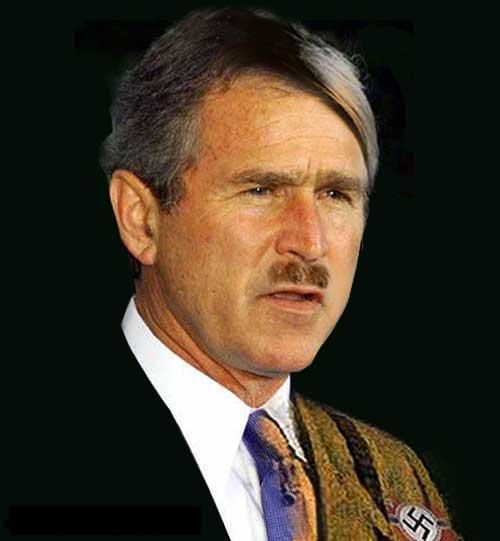
Published on Wednesday, March 4, 2009 by Consortium News
How Close the Bush Bullet
by Robert Parry
Earlier this decade when some of us warned that George W. Bush was behaving more like an incipient dictator than the leader of a constitutional republic, we were dismissed as alarmists, left-wingers, traitors and a host of less printable epithets.
But it is now increasingly clear that President Bush and his top advisers viewed the 9/11 attacks as an opportunity to implement a series of right-wing legal theories that secretly granted Bush unlimited power to act lawlessly and outside the traditional parameters of the U.S. Constitution.
These theories held that at a time of war – even one as vaguely defined as the “war on terror” – Bush’s powers as Commander in Chief were “plenary,” or total. And since the conflict against terrorism had no boundaries in time or space, his unfettered powers would exist everywhere and essentially forever.
According to his administration’s secret legal memos released Monday, Bush could waive all meaningful constitutional rights of citizens, including the First Amendment’s protections on free speech and a free press.
John Yoo, a deputy assistant attorney general at the Justice Department’s powerful Office of Legal Counsel – which advises a President on the limits of his constitutional powers – declared that Bush could void the First Amendment if he deemed it necessary to fight terrorism.
“First Amendment speech and press rights may also be subordinated to the overriding need to wage war successfully,” Yoo wrote in an Oct. 23, 2001, memo entitled “Authority for Use of Military Force to Combat Terrorist Activities Within the United States.”
Yoo then added ominously, “The current campaign against terrorism may require even broader exercises of federal power domestically.”
What was particularly stunning about Yoo’s reference to waiving the First Amendment – a pillar of American democracy – was his cavalier attitude. He tossed the paragraph into a memo focused on stripping Americans of their Fourth Amendment “right of the people to be secure in their persons, houses, papers and effects, against unreasonable searches and seizures.”
While saying that Bush could order spying on and military attacks against U.S. domestic targets at his own discretion as Commander in Chief, Yoo added, almost in passing, that the President also could abrogate the rights of free speech and a free press.
Wiping Out Public Trials
Another Yoo memo, dated June 27, 2002, essentially voided the Sixth Amendment and a federal law guaranteeing Americans the right to public trials. In the memo, Yoo asserted that Bush had the power to declare American citizens “enemy combatants” and detain them indefinitely.
“The President’s power to detain enemy combatants, including U.S. citizens, is based on his constitutional authority as Commander in Chief,” Yoo wrote, adding that “Congress may no more regulate the President’s ability to detain enemy combatants than it may regulate his ability to direct troop movements on the battlefield.”
Yoo acknowledged that in “war on terror” cases, an “enemy combatant” may have no formal connection to an enemy group, may have no weapon, and may have no discernable plan for carrying out a terrorist attack. In other words, an “enemy combatant” could be anyone that Bush so designated.
Under Yoo’s analysis, an alleged “enemy combatant” would have no legal recourse, since Bush’s Commander in Chief powers trumped even habeas corpus requirements that the government must show cause for imprisoning someone. Further, this opinion wasn’t just hypothesizing; it provided the legal basis for indefinitely detaining U.S. citizen Jose Padilla.
Though the U.S. Supreme Court ultimately issued a narrow 5-4 decision overturning Bush’s supposed right to deny habeas corpus and punish “enemy combatants” through his own military court system, many of Yoo’s concepts survived in the Military Commissions Act, which was passed by the Republican-controlled Congress in 2006.
While the law appears on the surface to target only non-citizens, fine print deep in the legislation makes clear that the Bush administration still was asserting its power to detain U.S. citizens who were viewed as aiding and abetting foreign enemies and to punish those citizens through military commissions that denied normal due-process rights to defendants.
“Any person is punishable as a principal under this chapter who commits an offense punishable by this chapter, or aids, abets, counsels, commands, or procures its commission,” the law states, adding that “any person subject to this chapter who, in breach of an allegiance or duty to the United States, knowingly and intentionally aids an enemy of the United States … shall be punished as a military commission … may direct.”
The reference to people acting “in breach of an allegiance or duty to the United States” would not apply to Osama bin Laden or al-Qaeda but would cover American citizens.
The Military Commissions Act remains in effect to this day, although President Barack Obama has vowed not to apply it, favoring use of regular civilian or military courts.
Loss of First Amendment
Though some of us have cited Bush’s determination to override key constitutional protections for years (see, for instance, our book Neck Deep), few critics – including me – thought to include the notion that Bush was interested in suspending the First Amendment.
The significance of Yoo’s throwaway paragraph about throwing away the First Amendment is that it suggests that the Bush administration intended as early as October 2001 to act against journalists and citizens who were viewed as undermining Bush’s “war on terror” through public comments or disclosures.
As a right-wing legal scholar, Yoo surely shared the Right’s knee-jerk animosity toward past reporting on the Watergate scandal and the Vietnam War’s Pentagon Papers, as well as contempt for Americans who demonstrated against the Vietnam War.
But his First Amendment reference also may have reflected the thinking of senior Bush aides in those early days of the “war on terror” as they collaborated with Yoo in formulating his legal opinions.
In his 2006 book War by Other Means, Yoo describes his participation in frequent White House meetings regarding what “other means” should receive a legal stamp of approval. Yoo said the “meetings were usually chaired by Alberto Gonzales,” then White House counsel, and involved Vice President Dick Cheney’s legal counsel, David Addington.
So, a seemingly incongruous reference to overriding the First Amendment – in a memo centered on overriding the Fourth Amendment – could be explained by the desire of White House officials to have some legal cover for actions aimed at journalists who were exposing secrets or whose reporting might weaken the national resolve behind Bush’s actions.
It also suggests that Bush’s critics who exercised their free speech rights in challenging his “war on terror” could have become targets of special government operations justified under Bush’s Commander in Chief powers.
In other words, Bush’s assault on America’s constitutional Republic may have been more aggressive than many of us imagined. It was a bullet that came close to the heart of a dream dating back to 1776.
© 2009 Consortium News
Robert Parry broke many of the Iran-Contra stories in the 1980s for the Associated Press and Newsweek. His latest book, Neck Deep: The Disastrous Presidency of George W. Bush, was written with two of his sons, Sam and Nat. His two previous books are Secrecy & Privilege: The Rise of the Bush Dynasty from Watergate to Iraq and Lost History: Contras, Cocaine, the Press & ‘Project Truth’.
Watch the whole show everyday at http:www.theyoungturks.com
30-minute uncut version:
http://video.google.com/videoplay?doc…
Bush White House: Millions of e-mails may be missing on hacking 2004 election and firing US Attorneys:
http://www.cnn.com/2007/POLITICS/04/1…
http://www.gwu.edu/~nsarchiv/news/200…
http://www.citizensforethics.org/node…
http://www.motherjones.com/politics/2…
http://www.gwu.edu/~nsarchiv/news/200…
http://airnetgroup.com
Michael Connell assassinated by plane crash, after grand jury testimony?
http://www.sourcewatch.org/index.php?…
Watch more at http://www.theyoungturks.com
President Obama explains how the budget he sent to Congress will fulfill the promises he made as a candidate, and assures special interests that he is ready for the fight. (this video is public domain)
Rachel Maddow interviews Left Behind authors Jerry Jenkins and Tim LaHaye.
http://cspanjunkie.org/
February 25, 2009 C-SPAN
http://cspanjunkie.org/
February 25, 2009 C-SPAN
From Big Easy to Big Empty
Check out the entire show at http://www.theyoungturks.com
http://cspanjunkie.org/
February 12, 2009 C-SPAN
September 11th Revisited v.2 is a follow up to perhaps the most riveting film ever made about the destruction of the World Trade Center. This is a powerful documentary which features eyewitness accounts and archive news footage that was shot on September 11, 2001 but never replayed on television. Featuring interviews with eyewitnesses & firefighters, along with expert analysis by BYU Physics Professor Steven E. Jones, Professor David Ray Griffin, MIT Engineer Jeffrey King, and Richard Gage, AIA, Architect.
Visit http://www.911revisited.com to get the DVD of this movie. You can also download or watch the entire film online for free. You are encouraged to copy this film and distribute it for non-profit educational purposes.
Website: http://www.911revisited.com
Doug Stanhope tells his version of the famous Aristocrats joke. http://www.dougstanhope.com
Watch more at http://www.theyoungturks.com.
George Bush is the worst president ever, says Bill Maher
Historians Richard Norton Smith and Edna Medford discussed C-SPAN’s Historian Survey of Presidential Leadership on Washington Journal. Historian Douglas Brinkley joined the discussion by phone. From Sunday, Feb. 15, 2009.
http://cspanjunkie.org/
February 12, 2009 C-SPAN
Watch more at http://www.theyoungturks.com


Disclaimer: All these pictures and mp3s are copyrighted by umm …. someone. If you like the following audio clips (like I do), please consider buying some Barack Obama books.
If you’re holding a copyright, trademark, anything on these pictures, files, … and think I’m infringing your rights, please let me know and I’ll remove this post.
Barack Obama – The Audacity of Hope – Disc 2 – (1 to 18)
Keith talks to Dan Gross about what happened when the financial market first started to melt down last September.
http://cspanjunkie.org/
February 10, 2009 C-SPAN

TREKKIE MONSTER:What you say?
BRIAN:
Kate wants to open a school for Monsters.
TREKKIE MONSTER:
School for Monsters? Me never hear of that!
(sung)
School for Monsters!
School for lonely little Monsters!
When me little,
going to school,
other children
think me not cool,
poking and pulling
at me fur…
Now me have therapist,
and work on this with her.
But me no need me therapy
if Monster School a reality!
(spoken)
Here! Me give you ten million dollars!
PRINCETON:
Trekkie! Where did you get all that money?!
TREKKIE MONSTER:
In volatile market, only stable investment is porn!
Rachel weighs in on Republican obstructionists to the stimulus bill.
If you’re holding a copyright, trademark, anything on these pictures, files, … and think I’m infringing your rights, please let me know and I’ll remove this post.
Barack Obama – The Audacity of Hope – Disc 1 – 02
Barack Obama – The Audacity of Hope – Disc 1 – 03
Barack Obama – The Audacity of Hope – Disc 1 – 04
Barack Obama – The Audacity of Hope – Disc 1 – 05
Barack Obama – The Audacity of Hope – Disc 1 – 06
Barack Obama – The Audacity of Hope – Disc 1 – 07
Barack Obama – The Audacity of Hope – Disc 1 – 08
Barack Obama – The Audacity of Hope – Disc 1 – 09
Barack Obama – The Audacity of Hope – Disc 1 – 10
Barack Obama – The Audacity of Hope – Disc 1 – 11
Barack Obama – The Audacity of Hope – Disc 1 – 12
Barack Obama – The Audacity of Hope – Disc 1 – 13 to 18
Keith’s Special Comment to Dick Cheney on his interview with Politico.
Rachel Maddow talks to Glenn Greenwald about Dick Cheney’s interview with his BFF’s at Politico where they gave him and the rest of the sock puppets in the MSM an excuse to repeat his talking points. I think the best argument Glenn made is that Cheney is setting the ground work for the media to attack Obama if we do get attacked and blame him if he ends some of the policies of the Bush administration which he knows were illegal but actually did nothing to keep us safe from terrorism and instead fostered it since the actions of the Bush administration have actually radicalized would be terrorists.
Rachel talks to Paul Krugman about what we need to do to get our economy moving and on the failures of Reagonomics and deregulation that have led us to the mess we’re in now.
Published on Friday, January 30, 2009 by CommonDreams.org
George Bush’s Gift To The World: The End of American Imperialism
by David Michael Green
George W. Bush was unquestionably the worst American president in the two and a quarter centuries of the country’s existence.
After all, James Buchanan, the previous aspirant to the title, merely did nothing while the South seceded. Hah! You’ll have to do better than that, Jimmy, if you want to wear this crown!
Bush did far better, of course. It would appear to be the one thing in his entire life he actually worked hard at, and the one challenge he was able to meet successfully. This was an astonishingly destructive presidency, that’s true even despite the fact that we don’t really know much about his administration, because in addition to being the worst, it was also the most secretive ever. (I’m sure that’s just a coincidence, too.) Moreover, that’s also even considering that most Americans still vastly underestimate the depravity of Team Bush. As I have argued previously, if you think they were ‘merely’ arrogant bunglers with exceptionally bad politics, you’ve grossly underestimated them. In fact, they were predators who launched their class warfare agenda behind the smoke-screen of national security, faux patriotism and secret government.
Does this record of unparalleled devastation mean that Bush never did anything right in eight years? No, though it’s pretty much the case that he never did anything right on purpose.
Unquestionably, however, Bush did make some positive contributions to American life, even if they were completely inadvertent, and even if they were dwarfed by the swath of destruction he left all across the landscape. Put simply, George W. Bush’s greatest success was that he gave a very bad name to very bad things.
Like the Republican Party, for example. Or conservative ideology. Or theocracy. Or presidents with the last name of Bush. Or emotional midgets who seek the White House as a salve for their personal psychological neediness.
We can be grateful for all these contributions, and I certainly am – though “thanks” is not likely what I would say if I had the pleasure of relating my assessment of Mr. Bush to him directly. More likely it would be something closer to the gracious words Dick “Dick” Cheney had for Patrick Leahy early on in the administration, when the two bumped into each other on the Senate floor. Those remarks were not, shall we say, fit for print in a family newspaper.
But I digress.
George Bush left us many gifts, but perhaps the greatest of them is that he has ruined the sport of imperialism in America, maybe forever.
Admittedly, that may of course be wishful thinking. Woe be unto the world, for example, should there be another 9/11 type of event. Somebody somewhere would have to pay in spades, and they likely wouldn’t be nice white folks.
And god only knows, alternatively, what Americans might be capable of under conditions of real resource deprivation. Considering what we’ve already done while being the richest and most powerful country in the world, it’s scary to think of what we could do with our back genuinely to the wall.
But leaving those unusual situations aside, it must be said that, after Iraq, the fun has really gone out of eviscerating small foreign countries, even those foolish enough to locate themselves on top of our oil.
Imperialism used to be a fairly sporting avocation for gentlemen of a certain class. You could occupy hapless Latin American countries, topple Iranian democracies, and simultaneously sponsor apartheid suppression of whole populations, still having time left by mid-afternoon for a couple belts with the boys down at the club, all in celebration of a good day’s work at the office. It was jolly good fun for all. Except, of course, for all for whom it wasn’t.
Unfortunately, that latter category included more or less the entirety of the southern hemisphere, and not a few in the north to boot. But, so what? We’re Americans! Caring about the morality of imperialism is for pre-dictatorship revolutionary anti-colonialist leaders and washed-up European former empires who can’t get it up anymore.
Truth be told, we’re now closer to being in that latter category than not, and we can thank George W. Bush for that, one of the few contributions of this complete and utter disaster going by the name of the 43rd presidency.
I’d say we’re more than a bit lucky for that outcome, too. Imagine if Iraq had been a success. Imagine if it had been the cakewalk they obviously thought it would be. Indeed, one of the great ironies of American politics is that Iraq probably readily could have been a ‘great success’, at least in terms of what could be marketed as such to a foolish American public.
In that sense, we are really quite fortunate, in a perverse sort of way, that Bush was as much a lazy boob as he was a warmonger. We are lucky that Rumsfeld was as dogmatic about his 21 century military ideas as Cheney was a completely psycho amoral sociopath. For had they simply run an occupation that was as carefully planned and as adequately staffed as the invasion, or had they toppled Saddam and then promptly left, “Mission Accomplished” would have been a lot more than some banner duct-taped onto the bridge of an aircraft carrier.
And that would have been very bad news indeed for the rest of the world. Syria, Iran, Venezuela, Cuba – there’s no telling where they might have gone next, and likely with the full support of the American public, at that point popping the buttons off their jingoistic shirts (made in Thailand, of course), their chests puffed out to the wall.
Americans were already growing dubious of regressive exploits in international adventurism, it seems to me. I remember laughing at the senior Bush, whose first pronouncement after defeating the pathetically under-matched Iraqi military in 1991 was “By God, we’ve licked the Vietnam syndrome once and for all!” Yeah, he actually said that. All I could think at the time was, if you have to say it, dude, it ain’t really happenin’. And all I can think now is, out of 300 million people in this country, did we really go to the Bush family twice to staff the presidency?
But, in fact, the Vietnam syndrome had not been licked. That war was a traumatic experience, and it changed public perceptions about the desirability of war itself. On top of which, America was not completely immune to the general Western post-World War II movement away from militarism as a means of settling disputes. Then there’s always been our long-standing vision of ourselves as both peace-loving and anti-imperialistic – however absurd those perceptions often were in light of actual practice. These also provided at least a speed-bump along the road to war in all but the more obvious cases.
Indeed, two things about public opinion and war in America struck me as pretty notable, but not much noted, these last years. One is that there was a surprising – I thought – lack of blood lust after 9/11. I guess part of that was that there was no state enemy to be attacked, as there had been in the past, and part of that was the foregone conclusion that we would be invading Afghanistan. But, really, I’m surprised there wasn’t a far more intense call for revenge. As one measure of the absence of this, consider that Osama bin Laden still has not been captured or killed, almost a decade (!) later, and that nobody seems much to care about that or mention it very often.
The other thing worth noting is that the public was, in fact, dubious about the Iraq invasion, right up until the weeks before. People realized that it was bogus, at some basic level, and they certainly had a hard time connecting it to 9/11. It took a marketing full-court press to eventually garner public support for the war (America’s pathetic excuse for a Congress was a lot easier to roll). It never worked abroad (another reason Americans were a bit slower to come on-board), but in the context of post-9/11 fears, a general tendency to trust the president, and the regressive movement’s prowess at equating militarism with patriotism, the Madison Avenue campaign finally produced a tenuous majority support for the Iraq invasion in the weeks right before it actually went down.
I think it’s slightly encouraging that, even in that context, it still took a real effort to sell the war. It’s also seriously discouraging, on the other hand, that it could be sold, and that it was. But, as noted, this was a tenuous acceptance. Had the war gone well it would have amplified the militarism in the Bush team and the country’s willingness to let them run rampant. Since it went disastrously, it had the opposite effect.
Iraq is probably not the last time America will go to war. But I think it’s fair to say that this country – its nose once more bloodied by a stupid imperial adventure, stupidly prosecuted – will be that much more reticent to repeat the experience. We do learn in America. It is often a painfully slow process, sometimes punctuated by reverse trajectories (can you say ‘creation science’), but we do occasionally exhibit the classic clinical signs of a student who can be taught, however reluctantly and inadvertantly.
And thus we owe a debt of gratitude to the Iraqis, perhaps a million of whom have been murdered, another four or five million dislocated, and countless others wounded – emotionally, if not physically, if not both – for helping us to learn. And the people of Syria and Iran and much of the rest of the developing world owe these Iraqis thanks as well, for giving the US pause from invading other countries at will.
America’s place in the world is likely to be entering a new period now, for several reasons. One is that the low-key successes of the Obama administration will help underscore the sheer lunacy of the Bush years, and all the policies associated with them. Another is that we are rapidly coming face-to-face with the reality that empire is expensive. As our standards of living go from mere steady decline to sheer precipitous decline, you’ll know that we’ve actually turned that corner when mainstream politicians finally have the courage to talk about scaling back expenditures on the obscenely bloated American military machine.
But, in the end, it may truthfully be said that no one did more to discourage American militaristic tendencies than Jingo George, himself, however odd that may seem.
And, who knows? If I ever met him, maybe I could even bring myself to thank him for that, after all.
But only, of course, from above, after I had decked him.
David Michael Green is a professor of political science at Hofstra University in New York. He is delighted to receive readers’ reactions to his articles (mailto:dmg@regressiveantidote.net), but regrets that time constraints do not always allow him to respond. More of his work can be found at his website, http://www.regressiveantidote.net.
Complete video at: http://fora.tv/2009/01/14/Uncommon_Knowledge_James_Woolsey
Former CIA director James Woolsey rejects the notion that the invasion of Iraq has triggered the end of neoconservativism in American politics, and argues the Iraq War was not a mistake.
—–
James Woolsey discusses the failure of the intelligence community in the run-up to the Iraq war and considers Barack Obama’s selection of Leon Panetta to head the CIA in light of the historical relationship between the president and the CIA director.
He outlines the challenges the intelligent community faces in what he calls America’s war against “theocratic totalitarianism.”
Finally, he asserts that it is imperative for us to destroy oil as a strategic commodity — not only for our security but also for the good of the planet – Hoover Institution
Robert James Woolsey is vice president of the consulting firm Booz Allen Hamilton and an officer in its global resilience practice.
Previously, Woolsey served as director of the Central Intelligence Agency and delegate-at-large to the US-Soviet Strategic Arms Reduction Talks and Nuclear and Space Arms Talks. He has also been a partner in the law firm of Shea & Gardner in Washington, DC.
Woolsey is currently co-chairman (with former Secretary of State George Shultz) of the Committee on the Present Danger, as well as chairman of the advisory boards of the Clean Fuels Foundation and the New Uses Council and a trustee of the Center for Strategic & International Studies and the Center for Strategic & Budgetary Assessments. He also serves on the National Commission on Energy Policy.
Peter M. Robinson is a research fellow at the Hoover Institution, where he writes about business and politics, edits Hoover’s quarterly journal, the Hoover Digest, and hosts Hoover’s television program, Uncommon Knowledge. Robinson is also the author of three books: How Ronald Reagan Changed My Life; It’s My Party: A Republican’s Messy Love Affair with the GOP; and the best-selling business book Snapshots from Hell: The Making of an MB.
http://cspanjunkie.org/
January 30, 2009 C-SPAN
I wouldn’t call this entertainment, but I guarantee you it’s the best 3.5 hours you’ll ever invest in your education. This amazing 3.5 hour documentary will teach you the entire history of money and banking, how it works and how the central bankers have robbed the wealth of nations, including our own. You’ll discover how bankers create the illusion that they have all the wealth, and how they get governments, corporations and all of us indebted to them, the primary mechanism they use to control virtually everything. You’ll also learn how they are the primary cause of all inflation, start virtually every war, and how they are engineering a world government and monetary system that they alone control…
Also watch FIREWALL: (http://newsbrowser.org/firewall/)
“The powers of financial capitalism had a far-reaching plan, nothing less than to create a world system of financial control in private hands able to dominate the political system of each country and the economy of the world as a whole…Their secret is that they have annexed from governments, monarchies, and republics the power to create the world’s money”
THE MONEY MASTERS is a 3 1/2 hour non-fiction, historical documentary that traces the origins of the political power structure that rules our nation and the world today. The modern political power structure has its roots in the hidden manipulation and accumulation of gold and other forms of money. The development of fractional reserve banking practices in the 17th century brought to a cunning sophistication the secret techniques initially used by goldsmiths fraudulently to accumulate wealth. With the formation of the privately-owned Bank of England in 1694, the yoke of economic slavery to a privately-owned “central” bank was first forced upon the backs of an entire nation, not removed but only made heavier with the passing of the three centuries to our day. Nation after nation, including America, has fallen prey to this cabal of international central bankers.
Segments: The Problem; The Money Changers; Roman Empire; The Goldsmiths of Medieval England; Tally Sticks; The Bank of England; The Rise of the Rothschilds; The American Revolution; The Bank of North America; The Constitutional Convention; First Bank of the U.S.; Napoleon’s Rise to Power; Death of the First Bank of the U.S. / War of 1812; Waterloo; Second Bank of the U.S.; Andrew Jackson; Fort Knox; World Central Bank;
Also recommended: “Firewall: In Defense of the Nation State”
http://video.google.ca/videoplay?docid=8415519765816415310
Video news on “Federal Reserve”: http://newstree.org/search.jsp?query=Federal+Reserve&hp=10&s=Video&vx=1
 Mike Nobody


